How to Make an if That Doesnt Check Again Once Its Fufilled

When does an asynchronous role finish? And why is this such a difficult question to answer?
Well it turns out that agreement asynchronous functions requires a great deal of noesis about how JavaScript works fundamentally.
Let'southward go explore this concept, and larn a lot about JavaScript in the procedure.
Are yous gear up? Let's go.
What is asynchronous code?
By design, JavaScript is a synchronous programming linguistic communication. This means that when code is executed, JavaScript starts at the elevation of the file and runs through code line past line, until it is washed.
The result of this design decision is that only 1 thing can happen at any i fourth dimension.
You can think of this as if you were juggling half dozen small balls. While you are juggling, your hands are occupied and can't handle anything else.
It's the aforementioned with JavaScript: in one case the code is running, information technology has its hands full with that code. We telephone call this this kind of synchronous code blocking. Because it's effectively blocking other code from running.
Permit's circle back to the juggling example. What would happen if you wanted to add some other ball? Instead of vi balls, you wanted to juggle seven balls. That'due south might be a problem.
You don't desire to stop juggling, because it's just then much fun. But you tin can't go and become some other brawl either, because that would mean you'd have to stop.
The solution? Delegate the piece of work to a friend or family member. They aren't juggling, so they can become and get the brawl for you, then toss it into your juggling at a time when your mitt is costless and you are prepare to add some other brawl mid-juggle.
This is what asynchronous code is. JavaScript is delegating the work to something else, then going near it's ain business. Then when information technology's ready, information technology will receive the results back from the piece of work.
Who is doing the other piece of work?
Alright, so we know that JavaScript is synchronous and lazy. It doesn't want to exercise all of the work itself, and then it farms it out to something else.
But who is this mysterious entity that works for JavaScript? And how does it go hired to work for JavaScript?
Well, let'south take a look at an case of asynchronous lawmaking.
const logName = () => { console.log("Han") } setTimeout(logName, 0) console.log("Hi there") Running this code results in the following output in the console:
// in panel How-do-you-do in that location Han Alright. What is going on?
Information technology turns out that the way we farm out work in JavaScript is to use environment-specific functions and APIs. And this is a source of great confusion in JavaScript.
JavaScript always runs in an environment.
Oftentimes, that environment is the browser. But it can also be on the server with NodeJS. Just what on earth is the deviation?
The difference – and this is of import – is that the browser and the server (NodeJS), functionality-wise, are non equivalent. They are often similar, just they are non the same.
Let'south illustrate this with an example. Let's say JavaScript is the protagonist of an epic fantasy book. Merely an ordinary subcontract kid.
At present let'south say that this farm child institute two suits of special armor that gave them powers across their own.
When they used the browser arrange of armor, they gained admission to a certain set of capabilities.
When they used the server suit of armor they gained admission to some other gear up of capabilities.
These suits take some overlap, because the creators of these suits had the same needs in certain places, merely not in others.
This is what an surroundings is. A place where lawmaking is run, where there be tools that are congenital on pinnacle of the existing JavaScript language. They are not a part of the language, simply the line is often blurred because nosotros use these tools every day when we write code.
setTimeout, fetch, and DOM are all examples of Web APIs. (You lot can see the full listing of Web APIs here.) They are tools that are congenital into the browser, and that are made available to the states when our code is run.
And because we always run JavaScript in an surroundings, it seems like these are part of the linguistic communication. But they are non.
Then if you've ever wondered why you can employ fetch in JavaScript when you run it in the browser (merely demand to install a bundle when you run information technology in NodeJS), this is why. Someone thought fetch was a practiced idea, and congenital information technology as a tool for the NodeJS environment.
Confusing? Yes!
But now we tin can finally empathise what takes on the work from JavaScript, and how information technology gets hired.
It turns out that it is the environment that takes on the work, and the way to get the surroundings to do that work, is to use functionality that belongs to the environment. For example fetch or setTimeout in the browser environment.
What happens to the work?
Corking. And so the environs takes on the work. Then what?
At some signal you need to get the results back. But let's remember almost how this would work.
Permit'southward go back to the juggling example from the beginning. Imagine you asked for a new ball, and a friend just started throwing the ball at you when you lot weren't ready.
That would be a disaster. Maybe yous could get lucky and catch it and get it into your routine finer. Merely theres a big chance that it may crusade you to drop all of your balls and crash your routine. Wouldn't it be better if you gave strict instructions on when to receive the ball?
Equally it turns out, there are strict rules surrounding when JavaScript can receive delegated work.
Those rules are governed by the event loop and involve the microtask and macrotask queue. Yes, I know. It's a lot. But bear with me.
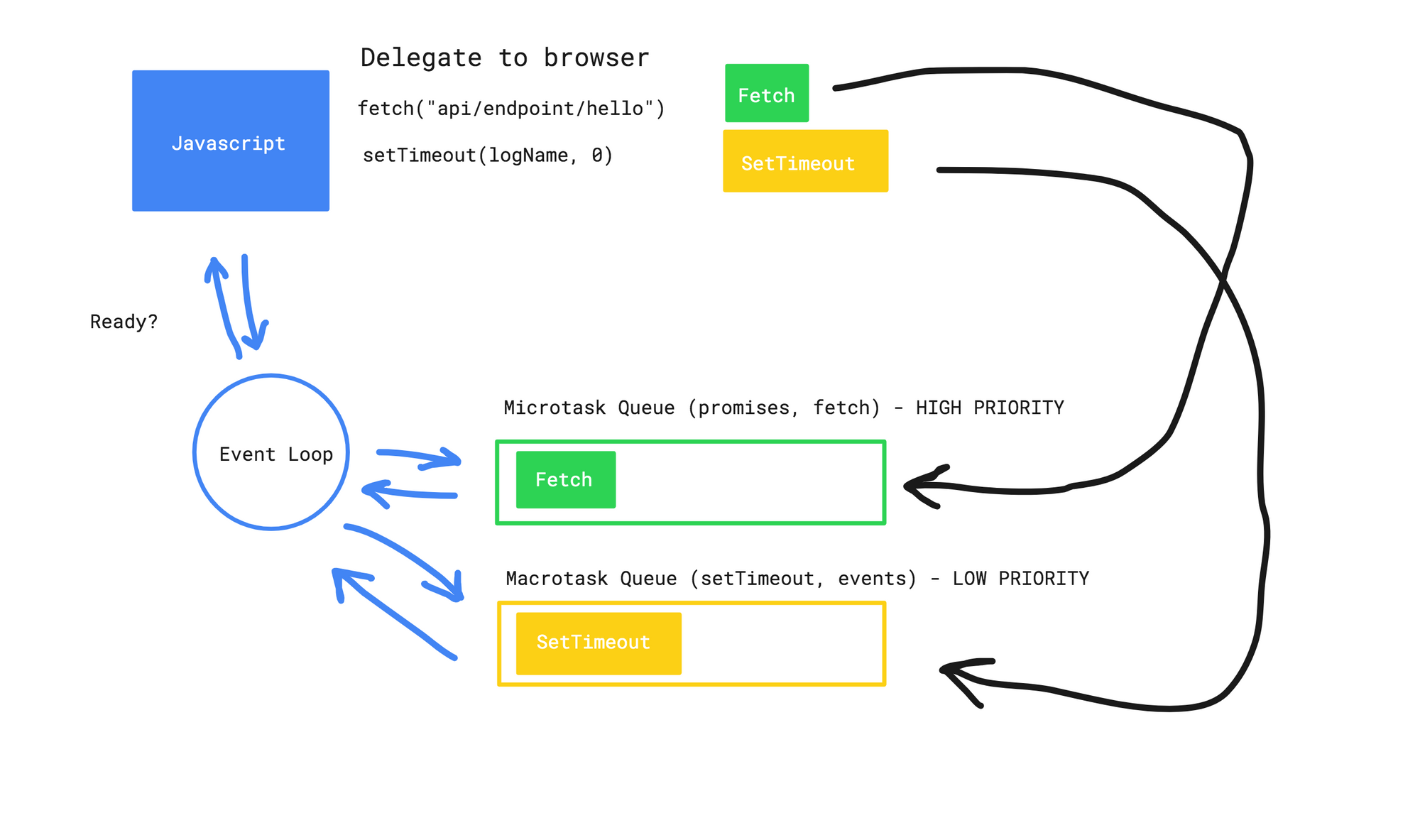
Alright. And then when nosotros consul asynchronous code to the browser, the browser takes and runs the code and takes on that workload. Simply there may exist multiple tasks that are given to the browser, so we need to make certain that we can prioritise these tasks.
This is where the microtask queue and the macrotask queue come in play. The browser will have the piece of work, do it, and then place the result in i of the two queues based on the type of piece of work it receives.
Promises, for example, are placed in the microtask queue and have a higher priority.
Events and setTimeout are examples of work that is put in the macrotask queue, and have a lower priority.
Now one time the work is done, and is placed in 1 of the 2 queues, the upshot loop will run back and along and cheque whether or not JavaScript is ready to receive the results.
But when JavaScript is washed running all its synchronous code, and is good and ready, will the outcome loop start picking from the queues and handing the functions back to JavaScript to run.
And then permit's accept a look at an example:
setTimeout(() => console.log("howdy"), 0) fetch("https://someapi/data").then(response => response.json()) .then(information => panel.log(data)) console.log("What soup?") What volition the order be hither?
- Firstly, setTimeout is delegated to the browser, which does the work and puts the resulting function in the macrotask queue.
- Secondly fetch is delegated to the browser, which takes the work. It retrieves the data from the endpoint and puts the resulting functions in the microtask queue.
- Javascript logs out "What soup"?
- The result loop checks whether or not JavaScript is ready to receive the results from the queued work.
- When the panel.log is done, JavaScript is set up. The event loop picks queued functions from the microtask queue, which has a higher priority, and gives them back to JavaScript to execute.
- Later the microtask queue is empty, the setTimeout callback is taken out of the macrotask queue and given back to JavaScript to execute.
In console: // What soup? // the data from the api // howdy Promises
Now y'all should accept a good deal of knowledge about how asynchronous code is handled past JavaScript and the browser environs. Then allow'due south talk nearly promises.
A promise is a JavaScript construct that represents a future unknown value. Conceptually, a promise is just JavaScript promising to return a value. Information technology could be the event from an API call, or information technology could be an fault object from a failed network asking. You're guaranteed to go something.
const promise = new Promise((resolve, decline) => { // Brand a network request if (response.status === 200) { resolve(response.body) } else { const error = { ... } reject(error) } }) hope.so(res => { console.log(res) }).catch(err => { console.log(err) }) A promise tin can have the following states:
- fulfilled - action successfully completed
- rejected - activity failed
- pending - neither action has been completed
- settled - has been fulfilled or rejected
A hope receives a resolve and a reject function that tin can exist chosen to trigger one of these states.
One of the large selling points of promises is that we tin can chain functions that we want to happen on success (resolve) or failure (reject):
- To register a function to run on success we utilise .then
- To annals a function to run on failure we use .grab
// Fetch returns a hope fetch("https://swapi.dev/api/people/1") .so((res) => panel.log("This function is run when the request succeeds", res) .catch(err => console.log("This function is run when the request fails", err) // Chaining multiple functions fetch("https://swapi.dev/api/people/1") .and so((res) => doSomethingWithResult(res)) .then((finalResult) => console.log(finalResult)) .grab((err => doSomethingWithErr(err)) Perfect. Now let's have a closer look at what this looks like under the hood, using fetch every bit an example:
const fetch = (url, options) => { // simplified return new Promise((resolve, reject) => { const xhr = new XMLHttpRequest() // ... brand request xhr.onload = () => { const options = { status: xhr.status, statusText: xhr.statusText ... } resolve(new Response(xhr.response, options)) } xhr.onerror = () => { reject(new TypeError("Request failed")) } } fetch("https://swapi.dev/api/people/1") // Register handleResponse to run when promise resolves .then(handleResponse) .catch(handleError) // conceptually, the promise looks like this now: // { status: "awaiting", onsuccess: [handleResponse], onfailure: [handleError] } const handleResponse = (response) => { // handleResponse will automatically receive the response, ¨ // because the hope resolves with a value and automatically injects into the role console.log(response) } const handleError = (response) => { // handleError volition automatically receive the error, ¨ // because the promise resolves with a value and automatically injects into the function console.log(response) } // the hope will either resolve or reject causing it to run all of the registered functions in the respective arrays // injecting the value. Let'south inspect the happy path: // 1. XHR event listener fires // 2. If the request was successfull, the onload event listener triggers // 3. The onload fires the resolve(VALUE) role with given value // iv. Resolve triggers and schedules the functions registered with .then And then we tin can use promises to do asynchronous work, and to be sure that we can handle whatever result from those promises. That is the value proposition. If y'all want to know more about promises you can read more almost them here and here.
When we use promises, we chain our functions onto the promise to handle the dissimilar scenarios.
This works, simply we still need to handle our logic within callbacks (nested functions) in one case we become our results back. What if we could use promises only write synchronous looking code? It turns out we can.
Async/Look
Async/Expect is a way of writing promises that allows us to write asynchronous code in a synchronous mode. Let's have a look.
const getData = async () => { const response = await fetch("https://jsonplaceholder.typicode.com/todos/1") const data = await response.json() panel.log(information) } getData() Zilch has changed nether the hood hither. We are still using promises to fetch data, only now information technology looks synchronous, and nosotros no longer have .then and .take hold of blocks.
Async / Await is actually just syntactic sugar providing a way to create code that is easier to reason about, without irresolute the underlying dynamic.
Permit'southward have a await at how information technology works.
Async/Await lets united states of america apply generators to suspension the execution of a part. When nosotros are using async / await nosotros are not blocking because the function is yielding the command back over to the main programme.
Then when the promise resolves nosotros are using the generator to yield command back to the asynchronous function with the value from the resolved promise.
Yous tin can read more hither for a not bad overview of generators and asynchronous code.
In effect, we can at present write asynchronous lawmaking that looks like synchronous code. Which means that it is easier to reason nearly, and we can use synchronous tools for error treatment such every bit try / catch:
const getData = async () => { effort { const response = wait fetch("https://jsonplaceholder.typicode.com/todos/1") const data = await response.json() console.log(data) } catch (err) { console.log(err) } } getData() Alright. So how practise we apply it? In order to use async / await we need to prepend the office with async. This does non make it an asynchronous part, it merely allows u.s. to use await inside of it.
Failing to provide the async keyword volition result in a syntax mistake when trying to utilize await inside a regular office.
const getData = async () => { panel.log("Nosotros can use await in this function") } Because of this, we can not use async / wait on summit level code. Only async and await are all the same just syntactic sugar over promises. So nosotros tin can handle top level cases with promise chaining:
async part getData() { allow response = await fetch('http://apiurl.com'); } // getData is a promise getData().then(res => console.log(res)).grab(err => console.log(err); This exposes some other interesting fact almost async / await. When defining a function every bit async, information technology volition always return a hope.
Using async / look can seem similar magic at first. But like any magic, it's just sufficiently advanced technology that has evolved over the years. Hopefully now you lot take a solid grasp of the fundamentals, and tin use async / expect with confidence.
Conclusion
If y'all fabricated it hither, congrats. Yous but added a cardinal piece of knowledge about JavaScript and how information technology works with its environments to your toolbox.
This is definitely a confusing subject, and the lines are not always clear. But now yous hopefully have a grasp on how JavaScript works with asynchronous code in the browser, and a stronger grasp over both promises and async / look.
If you lot enjoyed this article, you might also relish my youtube channel. I currently take a web fundamentals series going where I go through HTTP, building web servers from scratch and more.
There's as well a series going on building an entire app with React, if that is your jam. And I programme to add much more content here in the future going in depth on JavaScript topics.
And if yous want to say hi or chat well-nigh web development, y'all could ever attain out to me on twitter at @foseberg. Thanks for reading!
Acquire to code for free. freeCodeCamp's open up source curriculum has helped more than 40,000 people get jobs as developers. Get started
Source: https://www.freecodecamp.org/news/async-await-javascript-tutorial/
0 Response to "How to Make an if That Doesnt Check Again Once Its Fufilled"
Enviar um comentário