How Do You Know Movie Sound Track List
vulture lists
The twoscore Greatest Picture show Soundtracks of All Time
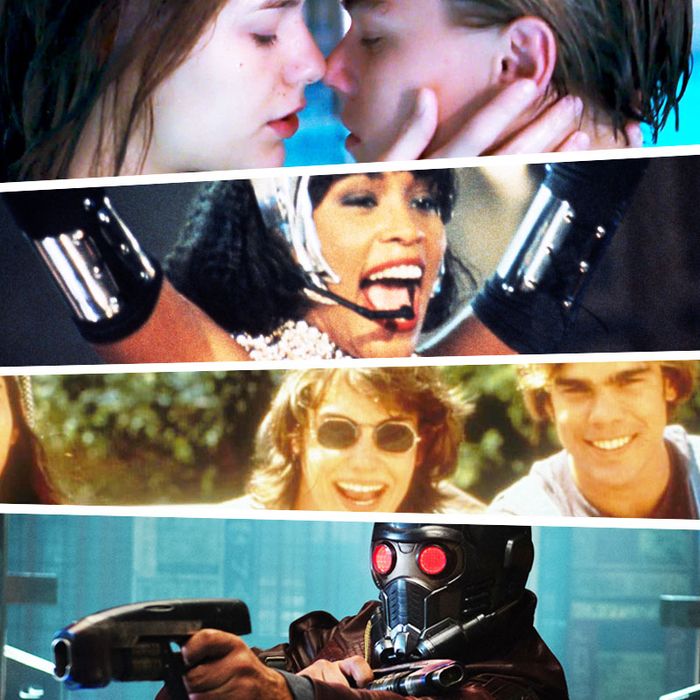
Photo: Twentieth Century Fox, Warner Home Video, Gramercy Pictures and Walt Disney Studios Movement Pictures.
This post has been updated to account for the release of A Star Is Born.
Blame Kenneth Anger. Back in 1963, the undercover artist and puckish provocateur debuted his movie Scorpio Rising, a 30-minute barrage of erotic imagery and American iconography, scored to unlicensed rock and R&B songs by the likes of Elvis Presley and Ray Charles. A staple of art-house cinemas and university film programs, Scorpio Rise influenced the mode that aspiring directors like Martin Scorsese would come up to recollect virtually the juxtaposition of moving pictures and popular music. When Scorsese'due south generation took over Hollywood at the end of the 1960s, they carried Acrimony in their hearts and minds.
Cutting to 2018, and if early projections hold, one of the yr'south most popular albums is going to be a soundtrack. Managing director/star Bradley Cooper'sA Star Is Born is the latest updating of a story that's been a cinematic perennial since the 1930s; and it's already a hit at the box part. A large part of the marketing has been focused on the music, with videos of performances by Cooper and his co-star Lady Gaga quickly going viral, well before the movie's release. The intersection of attracting images and tricky songs remains a reliable money-maker.
With A Star Is Born out this week, nosotros decided information technology was fourth dimension to determine the 40 best motion-picture show soundtracks of all fourth dimension. For this list, I leaned almost exclusively on the Scorpio Rising model: films scored from a variety of musical sources, many of them preexisting. There are a few exceptions. Information technology's difficult to skip over Shaft or Superfly, even though they were created past unmarried artists, exclusively for those projects. I'm too assuasive movies that characteristic diegetic musical performances (likePurple Pelting.Once, and, yes,A Star Is Born), though in order to avoid making this listing too unwieldy, I'yard excluding directly-up musicals. (Deplorable, Disney; sorry, MGM; deplorable, Grease.). I'm also skipping conventional original instrumental scores … fifty-fifty when they're unconventional, similar Miles Davis's soundtrack to Elevator to the Gallows, or Anton Karas'due south inescapable The Third Man zither, or the Brazilian bossa nova of Blackness Orpheus.
Instead, what you'll more often than not detect below are vocal-driven soundtracks that had pregnant cultural affect, in various ways: past becoming best sellers; past introducing (or reintroducing) songs to heavy radio rotation; by summarizing unabridged musical subgenres; or past helping to create singular cinematic moments. To cover equally much footing as possible, I express filmmakers known for their great soundtracks (like Fasten Lee and Sofia Coppola) to i entry each. Simply just virtually every modern musical genre is represented, from hip-hop to grunge to advanced classical.
Let's drop the needle….
Just like the N.W.A biopic, its soundtrack tracks the history of the hip-hop group from its earliest recordings to its post-breakup solo work. But the Straight Outta Compton album too includes some of the funk and R&B legends (in detail George Clinton and Roy Ayers) who helped inspire Dr. Dre's laid-back, bass-heavy W Coast sound. This isn't just a drove of some of the nigh influential recordings of the '80s and '90s, information technology's an origin story for how they came to be.
Some of the best single-artist soundtracks role as de facto compilations. Air-conditioning/DC has never released a proper "greatest hits" collection, just their album Who Made Who — featuring new and one-time songs that the Aussie hard-rockers let Stephen King utilise in his lone directorial effort, Maximum Overdrive — comes closest. "You Shook Me All Night Long," "Hells Bells," "For Those About to Stone" … these are staples of classic-rock radio and sports arenas, and a point from King that his moving picture most killer trucks is meant to be good, dumb fun.
Australian filmmaker Baz Luhrmann loves the big emotions and unapologetic artifice of old Hollywood movies and Superlative 40 music; so throughout his career he'southward been unafraid to score scenes with tricky tunes, fifty-fifty when they may seem on paper like a mismatch. His boffo Shakespeare adaptation is daring in the way it puts the Bard's words into the mouths of warring crime families in a mod coastal urban center. But Luhrmann then intensifies the anachronism by having his star-crossed lovers (played by an impossibly young and sugariness-looking Leonardo DiCaprio and Claire Danes) smooch and swoon to posh songs like the Cardigans' "Lovefool" and Des'ree'due south "Kissing You." The soundtrack went triple-platinum in the U.S., signaling pop culture'south motility away from gruff grunge and toward danceable romanticism with a synthesizer sheen.
Sofia Coppola'due south best flick makes analogies betwixt privileged royals and overexposed, misunderstood 21st-century celebrities. The soundtrack besides plays up those similarities across centuries, letting music by modernistic dance-popular acts and '80s mail-punkers pigment Marie Antoinette equally a typically moody kid, who unwinds by clubbing. Coppola'south previous soundtracks for The Virgin Suicides and Lost in Translation were similarly hooky and foggy, but Marie Antoinette is the finest example of how the director uses music to add dimension to her characters and setting.
French filmmaker Mia Hansen-Løve based Eden on the experiences of her brother Sven (who co-wrote the script), a moderately popular DJ whose career was overshadowed past his more successful EDM peers, including the guys in Daft Punk. The official soundtrack — which runs twice as long as the picture — is a fairly comprehensive survey of what Europeans kids were dancing to in the '90s. It'due south not essential to understand the fine distinctions between "house" and "garage" and "jungle" to enjoy all the swift tempos, bumping beats, soulful voices, and spare samples on Eden's score. Simply catch a glow stick and hit the floor.
The Oscar-nominated song "Beautiful Maria of My Soul" — performed in English past Los Lobos and in Spanish past Antonio Banderas — is probably the best-remembered part of the non-hitting movie adaptation of Oscar Hijuelos'southward novel The Mambo Kings Play Songs of Dearest. But the gold-selling soundtrack's lively revival of mid-20th century Latin jazz (with an emphasis on Puerto Rican and Cuban styles) is an outstanding intro to the genre, and caught the ears of a wider audience a few years before the Buena Vista Club became an international awareness. The moving-picture show of The Mambo Kings is a stirring story about how music helped two immigrant brothers find a place in America. The winning performances of Tito Puente, Celia Cruz, and Arturo Sandoval helped sell that tale.
This ludicrously twisty, overheated offense picture would be pretty justly forgotten were it not for its one-of-a-kind soundtrack: an experiment in creating a new musical genre. It's not that rap-rock didn't exist earlier Judgment Dark; acts like Trunk Count, Anthrax, Urban Trip the light fantastic Squad, and Beastie Boys had all produced some interesting hybrids prior to 1993. But unlike the "grinding metal meets bro boasting" format that would go commonplace in the belatedly '90s, Judgment Dark put some unlikely collaborators in the studio together: De La Soul with Teenage Fanclub; Sir Mix-A-Lot with Mudhoney; Business firm of Pain with Helmet; and Cypress Hill with both Sonic Youth and Pearl Jam. The results weren't always especially musical, only they did demonstrate refreshing openness and imagination.
One of the bleakest movies ever made nearly American teenagers — following a agglomeration of small-boondocks burnouts conspiring to comprehend up a murder committed past one of their friends — is accompanied by one of the harshest soundtracks always recorded. At a time when other '80s high-school movies were pepped upward by jangly college-rock and bouncy British synth-pop, River'south Edge leaned on the bludgeoning sludge of Slayer, Hallows Eve, and Fates Alert. No poseurs immune.
Though this self-consciously goofy one-act is about teenagers who desperately want to meet the Ramones, the soundtrack's really a hodgepodge of late-'70s New Moving ridge and art-rock, putting arguably the about important American punk band of all time in the context of performers like Nick Lowe, Brian Eno, Devo, and Todd Rundgren. Still, what makes this an essential document are the Ramones songs: the jet-fueled title track, the swinging retro-ballad "I Want You Effectually," and an 11-minute live medley that preserves the phase presence that made this band into rebel heroes.
The loftier-schoolers in Richard Linklater's 1976-set suburban Texas slice of life are convinced they're living through one of the lamest eras in American history. The songs blasting out of their car stereos propose otherwise. Possibly these kids missed the rebellious '50s and the radical '60s, simply the beatniks, hippies, and early rockers who came before them at to the lowest degree cleared the way for them to smoke dope all day and heed to Foghat, Alice Cooper, and ZZ Top. In the year of the American bicentennial, teenagers had never been so costless.
At its heart, Paul Thomas Anderson'south Boogie Nights is a smart-ass cinematic prank, answering the question, "What if a filmmaker applied the sweeping, emotionally intense, visually dynamic storytelling of Goodfellas to a moving-picture show about porn?" The soundtrack is part of that joke. In the place of Martin Scorsese'south collection of classic popular, rock, and R&B, Anderson fills his movie with catchy cheese like Melanie's "Brand New Fundamental," Walter Egan'southward "Magnet and Steel," and Night Ranger'south "Sis Christian." Because what ameliorate way is in that location to score a moving picture about guilty pleasures?
Information technology has a better reputation now, but when Empire Records was released in the mid-'90s, it bombed at the box function and underwhelmed critics, who pegged this "solar day in the life of a tape store" dramedy every bit a cynical endeavor to smooth and sell the post-Nirvana alt-rock scene. Nevertheless, the movie resonated with a small but fervent audition, who helped elevate it to cult status, while clinging passionately to a soundtrack filled with modern rockers like Gin Blossoms, Meliorate Than Ezra, Toad the Wet Sprocket, Cracker, and the Cranberries. Both the film and its score certificate an era when the eccentricities of early-'90s music were straightened out and floated into the mainstream, and both make the case that even something blatantly commercial can even so exist meaningful to the people who buy it.
Cameron Crowe started writing the picture show that would become Singles not long afterward he moved to Seattle, where the onetime Rolling Rock reporter was immediately impressed with the then-underground music scene. By the time Crowe finished the film, his friends in bands similar Soundgarden, Pearl Jam, and Mudhoney were some of the biggest rock stars in the world. Singles only pulled small-scale box-role returns, just its soundtrack album was huge — not merely considering it captured "grunge" at its acme, but because Crowe framed the move well, calculation songs by '80s alt-rock hero Paul Westerberg, '70s FM star Nancy Wilson (Crowe's married woman at the time), and legendary Seattleite Jimi Hendrix to show where the likes of Alice in Chains and Screaming Trees came from.
When writer-director John Carney's shoestring indie drama Once debuted at Sundance in 2007, Glen Hansard was just an Irish singer-songwriter known to a scattering of rockists diligent plenty to exist aware of his band the Frames. Then this story of an amateur street musician — coming together a woman (played Markéta Irglová) who inspires him to tape a demo — and so moved audiences that Hansard and Irglová'south songs "Falling Slowly" and "When Your Heed's Made Up" became radio hits and won major industry awards, before going on to anchor a Broadway musical version of the motion picture. Which just goes to evidence: Who needs a big budget when you lot've got keen tunes?
Fifty-fifty in a era when no 1 really buys albums anymore, fans of Curiosity's derisive cosmic gamble pushed its soundtrack to the pinnacle of the charts. Why? Credit the likable mix of '70s Top 40, heavy on songs like Elvin Bishop's "Fooled Around and Vicious in Honey" and 10cc's "I'chiliad Not in Love" that are fondly remembered but not overplayed on oldies radio. Credit also the way this "awesome mix" is used in the actual motion-picture show: as the last remaining bond between a star-hopping rogue and the belatedly mother who taught him to honey the hits.
More than just a collection of tunes that were featured in the motion picture, this soundtrack aims to recreate the whole experience of the latestA Star Is Built-in, with dialogue snippets and multiple versions of the aforementioned numbers, only like in the pic. Preserving the about documentary-like quality of the musical performances besides allows this record to hold onto the tension at the heart of the picture: betwixt the bawdy spontaneity of the rootsy alt-rock that Bradley Cooper'south grapheme Jackson Maine sings (with words and music contributed by the likes of Jason Isbell and Lukas Nelson, son of Willie) and the more than polished, practiced pop of Lady Gaga's Marry. The songs tell a story, nearly the different ways of retaining some personal expression within the soulless behemoth that is the modern American recording manufacture.
Martin Scorsese may be the filmmaker from the '70s "New Hollywood" heyday virtually closely identified with hymeneals dynamic images with gritty rock and soul. With Mean Streets in the '70s, Goodfellas in the '90s, and The Departed and The Wolf of Wall Street in recent years, Scorsese and his editor Thelma Schoonmaker — and well as his occasional musical consultant Robbie Robertson — have created fully integrated sound-visual experiences that other artists have shamelessly tried to copy. The squad's boldest work generally eschews popular music (aside from a few dreamy oldies) in favor of passages from advanced classical composers. Besides drawing attention to the mod geniuses of a wholly different genre, the unfamiliar, almost alien sounds of the Shutter Island soundtrack reinforce the movie'south tale of hallucinatory madness.
It's hard to get wrong with just most whatsoever soundtrack from just about any Spike Lee joint: the go-go heavy School Daze, the Public Enemy–anchored Do the Correct Affair, Stevie Wonder'southward Jungle Fever, Prince's Girl 6, and so on. But Mo' Better Blues may exist the score that'southward closest to Lee's heart. The motion-picture show is partially inspired by his own jazz musician father, Pecker Lee (who equanimous the title track), and it's set to a mix of original Branford Marsalis and Terence Blanchard numbers that run the gamut of jazz styles, from sultry vocal ballads to snazzy melodic pop to avant-garde racket. The album's most vital rail may be Gang Starr's "Jazz Matter," a hip-hop history of the genre that many neophytes accept used as a recommendation list for what to listen to: from Theolonious Monk ("a melodious thunk") to Ornette Coleman ("another soul man").
1 of the most beloved movies of the late '60s — and a Best Motion picture Oscar winner to boot — Midnight Cowboy is also a detailed report on how the era of LSD and gratis love played out in a grimy New York City, where harder sexual activity and drugs were more than popular than the happy hippie kind. The soundtrack too plays with the sounds of the urban center and the times. The mind-bending drone of Elephant's Memory (doing their all-time Velvet Underground impression) sits next with the lyricism of John Barry's harmonica-driven instrumentals, the ersatz grooviness of the Groop, and Harry Nilsson'southward shatteringly cute embrace of Fred Neil's "Everybody'south Talkin'." The latter track in item, playing nether images of 2 pathetic hustlers striding through Manhattan, captures both the possibilities and the disappointments of a and then-crumbling urban center.
It'southward impossible to talk about the wedlock of movies and pop music without mentioning the Beatles, whose films A Hard Twenty-four hours's Night, Help, and Yellow Submarine influenced cinema, television, fashion, the counterculture … you name it. Only the best bodily Beatles soundtrack comes from their worst motion picture. The rambling, muddy-looking, made-for-TV Magical Mystery Tour is a job to watch: all within jokes and secondhand psychedelia. Merely the anthology is wall-to-wall classics, including "The Fool on the Hill," "I Am the Walrus," "Howdy, Adieu," the title track, and the contemporaneous singles "Strawberry Fields Forever" and "All You Need Is Love." The latter 2 weren't in the movie itself, merely they corroborated what the band was up to musically at the time, marrying timeless melodies to potent trippiness.
One of the movies that signaled a shift in Hollywood toward youth-oriented A-list productions, The Graduate used music that appealed both to kids and their parents, shifting hands between Dave Grusin's traditional orchestral swing and the winsome folk-stone of Simon & Garfunkel. The images of a soul-sick Dustin Hoffman — playing a vivid young human not quite ready to be a grown-up — set to pretty, melancholy songs like "Mrs. Robinson," "Scarborough Fair," and "April Come She Will" persuaded older viewers that mayhap something really was troubling the rising generation. The phenomenal sales for the soundtrack and the "Mrs. Robinson" single convinced the studios to commencement prowling Dusk Strip, looking for the long-haired musicians to stick a microphone in front of.
Thanks to the Beatles and The Graduate, the stone film soundtrack had developed a kind of formula past the end of the '60s: mostly performed by single artists, relying on a mix of one-time hits and new recordings, padded out with some novelty tracks and instrumental filler. And then Dennis Hopper and Peter Fonda decided to dedicate a big part of their Easy Rider upkeep to licensing the popular acid-rock songs that their editor Donn Cambern was at first just using every bit a temporary score. In addition to sounding of-the-moment with its fresh Steppenwolf and Byrds cuts, Easy Passenger just felt more organic than the soundtracks that preceded information technology — more like something the pic's characters would really be listening to.
If nix else, the baby-boomer fave The Big Arctic was responsible for what would get one of the biggest Hollywood cliches of the '80s and '90s: the scene of joyful middle-aged folks bopping around their house to a well-loved popular oldie. In the example of The Big Chill, this story of hippies turned yuppies sparked a renewed involvement in '60s ideals during the eye of the Reagan era — and it restored some commercial viability to Motown classics and vintage AM radio hits by the likes of Creedence Clearwater Revival and Procol Harum. The soundtrack commodified the pervasive feeling in the culture that something vital was existence lost.
Xxx-two meg copies. That'due south the crude tally of international sales for the Dirty Dancing soundtrack: a surprise smash, accompanying a modest period romance that itself became a much bigger striking than anyone expected. Though information technology'south set in 1963 — and features a score dotted with pre-Beatles pop from the likes of the Ronettes and the V Satins — this story of an underestimated teen and the hunky dance teacher who notices her felt remarkably mod back in 1987. A lot of that had to practise with songs similar Patrick Swayze'southward "She's Similar the Wind," Eric Carmen's "Hungry Optics," and Bill Medley and Jennifer Warnes's Oscar-winning "(I've Had) The Time of My Life," all of which sacrifice '60s authenticity for gimmicky snap.
Make no mistake: The Bodyguard has the biggest-selling soundtrack of all time (an estimated 42 million copies sold worldwide) because of Whitney Houston's peerless recording of Dolly Parton'due south "I Will Always Honey You," which spent fourteen sequent weeks as Billboard'south No. 1 song on the Hot 100 Singles chart. But the album overall is also an fantabulous collection of early-'90s adult-gimmicky pop, highlighted by the half-dozen polish and soaring Houston numbers that occupy the first half. Side two mixes low-cal jazz and soft soul, rounding out the record's — and the picture show'due south — air of sophisticated romance.
A film about Scottish heroin addicts shouldn't experience every bit full of life every bit Trainspotting does. Credit manager Danny Boyle, screenwriter John Hodge (adapting Irvine Welsh's novel), and a gear up of songs that exemplifies wastrel cool. The film and the soundtrack both boot off with Iggy Pop's exultant ode to decadence, "Animalism for Life," and what follows is a mix of tracks that range from druggy glam (Lou Reed's "Perfect Day") to post-punk disco (New Order's "Temptation") to '90s rave faves (Underworld'south "Born Slippy .NUXX"). The music's by and large pretty and mostly danceable, merely is underlaid throughout with a sense of worldly danger.
Two rites of passage for aspiring punks in the mid-'80s: finding a video shop hip plenty to stock Alex Cox's eccentric saga of Fifty.A. deadbeats, crafty creditors, and alien life forms; and then ownership, borrowing, or stealing a copy of the Repo Human being album. Anchored by some of the titans of the early West Coast hard-core scene (Black Flag, Suicidal Tendencies, Circumvolve Jerks, Fear), this soundtrack is at in one case a primer on one of the major punk scenes, and a drove of songs so tuneful and witty that it proves even astringent-looking people with piercings and shaved heads can have a sense of sense of humor.
The clichéd crime drama Belly is marginally fascinating today, if only for the way that author-director Hype Williams tries and mostly fails to translate his flashy music-video style to the big screen. But the pic is improve remembered for its soundtrack, which just happened to catch the New York hip-hop scene as it was undergoing an of import development. With contributions from Jay-Z, Nas, DMX, D'Angelo, and several members of the Wu-Tang Clan — all either at the height of their creative powers or just about to be — the Belly album catches East Coast rap's move toward harder edges, starker lyrics, and more sophisticated musical arrangements. Who would've expected that a message from the genre'due south future could be transmitted via some impuissant B movie?
Before hip-hop acts started regularly getting MTV airplay and hitting the Summit x, a lot of middle Americans relied on soundtracks from rap cash-in movies similar Beat Street and Krush Groove for an like shooting fish in a barrel mode into the genre. True connoisseurs tracked down the score for Wild Manner, put together by Blondie guitarist Chris Stein and entrepreneurial MC "Fab V Freddy" Brathwaite, with writer-director Charlie Ahearn. The trio fabricated expert employ of their friendships with influential New York rappers similar Busy Bee, Double Trouble, and the Cold Vanquish Brothers, and recorded the kind of energetic street rhymes that had previously only appeared on unofficial "boxing tapes." Like the film, the soundtrack preserves an essential piece of musical history.
In the '80s, Hollywood studios became multimedia conglomerates, working synergistic deals with other corporations to deliver not just movies, but marketing opportunities. Cynics would say that the large bosses back then crushed the original outlaw spirit that divers American filmmaking in the '70s. Fans would counter that the product that came out of this era — the toys, the comics, and aye, the albums — was and then well-made that it justified the sell out. Between 1983 and 1987, pretty much every yr featured a mammoth soundtrack: Flashdance, Top Gun, Dirty Dancing … and the king of them all, Footloose, which stacked upwards six Top forty hits, all recorded for the film. Sure, the songs are all motorcar-tooled to dominate the mainstream. Just acts like Deniece Williams, Bonnie Tyler, and Kenny Loggins (the '80s soundtrack king) also made them catchy as hell, with an upbeat vibe that defines 1984 likewise as Easy Rider does 1969.
Past the time Quentin Tarantino fabricated his quaternary and fifth films, fans pretty much knew what to await from his soundtracks: a couple of half-forgotten pop hits, some classic R&B, a few obscure garage-rockers, and snippets of dialogue. But the two Impale Bill movies were designed to show that Tarantino could tell stories torn from the heart of pulp fiction, not just the margins — and their soundtracks, too, were an expansion of the filmmaker's palette. In betwixt typically Tarantino-friendly songs like Nancy Sinatra's "Blindside Bang" and Johnny Cash'due south "A Satisfied Mind," the movies and their scores borrowed freely from the work that composers like Ennio Morricone and Luis Bacalov had done for former spaghetti Westerns and thrillers. Tarantino fifty-fifty resurrected the title theme from the Japanese offense moving picture New Battles Without Award and Humanity, turning it into a ubiquitous stadium anthem.
It's perhaps the ultimate compliment to a filmmaker when his or her style becomes so well-known that information technology can be parodied … correct down to the soundtrack. Role of what made Wes Anderson's Rushmore such a revelation when it arrived at the end of the '90s was that the manager and his co-writer Owen Wilson took the moving, relatable story of a high-schoolhouse misfit — a pretty common motility-picture premise — and gave it the theatrical flair that the grapheme himself would've adopted if he were making a movie about his life. The hero'due south dramatically cocky-witting persona is reflected in the flick's music: a fix of '60s British Invasion deep cuts that make the whole moving-picture show experience displaced from time. Like many of the other great soundtracks on this list, Rushmore established a template that many other filmmakers and music consultants still follow.
In the '80s, writer-director-producer John Hughes hitting upon the perfect formula for teen-moving-picture show gilt: Tell familiar stories about popularity and romance, set to music so hip that even high-school weirdos became fans. The Hughes-penned immature-adult favorite Pretty in Pink takes its proper noun from a punky Psychedelic Furs song (rerecorded for the film to be much smoother) and features a soundtrack that'southward a who'southward who of angsty British popular. The Smiths, Echo & the Bunnymen, Orchestral Manoeuvres in the Nighttime, New Order … if viewers weren't already fans of these acts before they arrived at the multiplex, the album practically served as a checklist for what truly absurd kids should be listening to.
Disco was mostly a niche genre earlier youth-savvy multimedia impresario Robert Stigwood produced a picture near rough-hewn working-class New Yorkers, enjoying moments of grace and cocky-expression on the dance flooring. The film became a blockbuster, and its soundtrack became the disco album that even people who'd never been to a club had on their shelves. A mix of kitschy novelty numbers (like Walter Tater's "A Fifth of Beethoven"), '70s pop classics (The Trammps' "Disco Inferno"), and some of the Bee Gees' all-time trip the light fantastic numbers, Sabbatum Dark Fever spread the disco craze beyond the country and the globe, popularizing the music to such a degree that in the years that followed musicians who wanted to sell records were all merely required to give their songs a thumping beat.
Even fervent music buffs didn't know a lot about ska or reggae before a scruffy picayune Jamaican crime picture became a cult striking worldwide. Set on the fringes of the Kingston recording manufacture, The Harder They Come put a spotlight on the lilting rhythms and tropical haze of a musical mode that was just starting to get exported more widely. The picture show and soundtrack fabricated a star of leading man Jimmy Cliff, whose wiry energy and raspy vocalism connected cross-culturally. Songs similar "Rivers of Babylon" and "You Tin Get It If You Actually Want" were easy on the ears, no matter how askew their tempos.
Every now and then, writer-directors Joel and Ethan Coen make a moving picture that reaches a wider audience, even though the brothers themselves inappreciably ever modify much virtually their offbeat way or personal preoccupations. The cornpone comedy O Brother, Where Art Thou? was 1 of those left-field hits, and was buoyed in part by its octuple-platinum soundtrack: 1 of the few LPs of flick music to win an "Anthology of the Twelvemonth" Grammy. (Sabbatum Night Fever is another, as well equally The Bodyguard.) Produced by T Os Burnett, the O Brother score re-creates the sound and feel of Low-era folk and country, with gloomy murder-ballads and half-ironic anthems of promise conjuring up the ghosts of what critic Greil Marcus once called "the old, weird America."
Prince fictionalized his ain rising through the Minneapolis R&B scene for Majestic Rain, a motion picture about an eccentric genius mocked past his peers for his cross-genre hybrid music and erotically charged phase shows. The picture'southward entertaining, but kind of ridiculous, given that it features the songs and live performances of an artist so on top of his game that only a stubborn dolt could deny his awesomeness. However the soundtrack is bulletproof. "Permit's Go Crazy," "I Would Die four U," "Baby I'm a Star," "When Doves Cry," "Regal Rain" … at that place'southward a reason why these songs turned Prince from a pop oddball to a culture-pervading superstar.
Earlier Isaac Hayes was tapped to write, produce, and perform the soundtrack to the gritty detective picture Shaft, he was already known as one of R&B'due south great innovators, thanks to his epic-length, richly orchestrated covers of white artists' hits. Shaft ended upwards being a revolutionary film, finding such a big African-American audience that information technology inspired the low-budget activeness genre that came to be known every bit "blaxploitation." Hayes's music was groundbreaking, too. His theme song won an Oscar, and his album — the first double LP from a soul deed — won multiple Grammys. Shaft established a decorated, soaring sound that endless movies and cop shows in the '70s would emulate.
Shaft was the groundbreaker for blaxploitation soundtracks, but Superfly is the masterpiece that Curtis Mayfield built atop Isaac Hayes's foundation. Onscreen, Mayfield'southward songs annotate on the activeness, capturing both the outlaw cool of a drug dealer's life, and the real human cost of the products he sells. On record, Superfly is an near overwhelming listening experience, with lush strings and polyrhythmic percussion defining funk at its almost sophisticated. The moving-picture show's virtually unnecessary. The album itself is plenty cinematic.
Before his whole life and career became all most Star Wars, George Lucas was known around Hollywood every bit a nerdy cinephile with artsy, experimental inclinations — more than of a Kenneth Anger than a Steven Spielberg, in other words. Considering of his rep, expectations were low for what turned out to be Lucas's quantum movie: an elliptical ensemble piece, set in modest-boondocks California in 1962, scored to an unceasing stream of early rock and doo-wop hits. The soundtrack was a costly extravagance that Universal Pictures initially balked at — simply it turned out to be i cardinal to the movie's stunning success. The use of these real old songs by Fats Domino, the Platters, Chuck Drupe, and the like — instead of the cheaper simulations the studio wanted — lent a docu-realism to Lucas'south impressionistic portrait of restless teens. The music also struck a nostalgic chord in the audience, which would keep reverberating throughout the decade, affecting the kind of stories Hollywood would tell and the kind of tunes they'd set them to. The anthology version was cleverly synthetic likewise, using legendary DJ Wolfman Jack's voice every bit a bridge between propulsive pop that never quits. Like near all the collections on this list, the American Graffiti LP instantly brings dorsum nearly everything fans love about the motion picture. All that's missing is a hot rod.
Source: https://www.vulture.com/article/best-movie-soundtracks-ranked.html
0 Response to "How Do You Know Movie Sound Track List"
Enviar um comentário