what finish is best to use on outdoor timber frame

UPDATED 23Apr2020 + video beneath: I live in Canada, and my country probably grows more big copse than any other nation in the globe. The thing is, you lot'd never know information technology by looking at most of our houses. Even though wood is nigh ever involved in Canadian domicile building, it's typically sawn into boring, uniform i one/2"-thick planks, spiked together with no thought for advent, then hidden under drywall. That's besides bad considering the reality is that it'southward never been easier to contain big, majestic, visible timbers into renovations and new homes. That's why I want to innovate you to a handful of innovative technical details that can bring visible timbers to most homes. To empathise the logic behind these approaches, you first demand to empathize why timbers and then rarely make it into homes and cottages in the starting time identify.
Timbers are big, heavy and more difficult to source than regular lumber. People who can skillfully cutting and bring together timbers in traditional means are fifty-fifty harder to notice than the forest itself. Physical challenges and labour realities similar these have always been part of building with timbers, it's just that nosotros've sidestepped them with more modern, less elegant methods. Typically, standard lumber is milled into planks 1 1/2″ thick by the truckload, and then joined together with nail guns by armies of workers paid by the slice. This makes for more affordable houses, only it as well stifles the kind of majesty and grandeur that only large, exposed timbers can conjure.
Over the last 30 years I've used various unconventional methods to contain structural timbers into my home renovation and building projects. Here are 3 that I particularly like.
Timber Frame Homes: The Hybrid Approach

Traditional timber frame homes are still built today as they've always been, with big wood joined together without metal fasteners, then raised upright to course walls and roofs. This is a beautiful thing indeed, only out of reach financially for well-nigh people. One manner to ease the cost and complexity of this process, while still retaining most of the stunning interior advent of traditional timber framing, involves combining modern stud frame outer walls with timber frame posts and beams raised ane at a time wherever they'll exist visible in the completed structure.
While this approach may offend purists, it does make it more affordable and practical for ordinary people to make existent timbers part of everyday life. Traditional timber joinery techniques such as pegged mortise and tenons, dovetails, let-in genu braces and visible overhead beams are all all the same possible and practical with this hybrid approach, while the attempt of raising the components is significantly reduced because the timbers become up one past one, not unabridged frame sections at once. My favourite timber framing guidebook is Edifice the Timber Frame House: The Revival of a Forgotten Craft past Tedd Benson. It covers everything you need to know virtually the old-fashioned joinery side of things. As for how your traditional timber beams and posts interface with modern stud frame walls, this involves a couple of uncomplicated tricks.
The chief engineering difference between stud frame walls and timber frame structure has to do with how loads are distributed. Stud frame walls distribute loads much more evenly across their length than the large point loads typical of timber beams. To accommodate this fact y'all demand to create composite posts inside stud walls wherever they're supporting beams above. Where an 8×x main beam joins to an outside wall, for instance, spike iv or five 2×6 studs together vertically within the wall frame, immediately below the axle, to create a kind of blended mail. Smaller beams, such equally 6x8s spaced 24" on center to replace conventional floor joists, can rest direct on the double top plate of a stud wall. Either way, I employ 8", x" and 12" spikes to secure timbers to the underlying stud frame wall structures. Predrill holes through the beams to make sure the spikes drive straight. All timber connections themselves are fabricated using traditional joinery methods.
Timber Frame Homes: Build-Up Beams
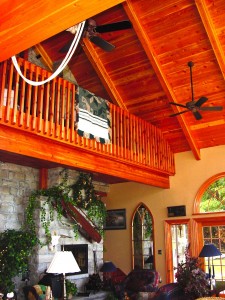
Sometimes fifty-fifty the weight of handling and raising solid timbers one at a time is a problem, and at times like these congenital-up timbers brand sense. They're fabricated from ordinary, construction-class 2×8, 2×10 and 2×12 planks bolted together, but don't let that homely description fool you lot. Built-up beams provide surprisingly cute results when sanded, routed and bolted together with intendance. This approach works well indoors or in sheltered outdoor applications, too. Built-up beams are as well less probable to inflame your building inspector. Concealed versions of built-up beams are a regular office of modern home edifice, so your inspector has charts for commanded span, beam width and beam thickness.
The fact that y'all're using composite beams in an exposed application makes no technical difference, though at that place are steps to follow if you want built-upwardly beams to look good when you're washed. If you commodities three or four 2x10s together, the result volition look pretty much like three or 4 2x10s. Ugly. That's not terrific, just it doesn't have to be this fashion for you lot. Three simple steps make all the difference.
My favourite arroyo begins with a small 45º chamfer bit in a small laminate router to mill angled edges wherever planks meet each other as they're bolted together. Besides looking not bad, chamfered edges hide the slight simply inevitable mismatches that occurs between boards equally they're bolted together. The outer edges of composite beams also look best milled with a much larger chamfer bit, with the profile stopping several inches earlier the edge of the beam meets bordering surfaces. You'll observe wooden hand screws most useful for aligning multiple boards as you lot're marking, drilling and bolting them together.
While you could employ nails or screws to hold the layers of a built-upward beam tight, one/2" diameter wagon bolts, flat washers and nuts are much ameliorate on three counts. First, they permit you lot pull the layers of wood together and agree them with a lot of strength. The domed heads of carriage bolts also await pretty good. And if your composite axle will spend its life in a heated, indoor space, bolts also allow the option of adding more tension when the layers of wood inevitably shrink.
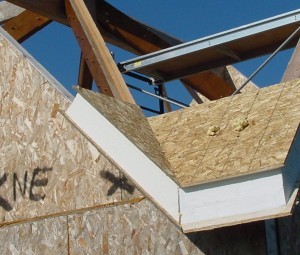
At that place'due south ane other state of affairs where built-up beams actually shine. In cases where you need a beam to support a roof valley, the built-up approach can't be beat. The layered design allows inward sloping angles to be sawn on the top edges of the planks before the layers come together. This creates the platonic trough-similar shape necessary along the meridian of the beam to properly support roof capsule. This is fifty-fifty more important when you lot're building a roof with structural insulated panels because of the higher betoken loads involved.
Timber Frame Homes: Metallic Hardware Helps
Preparing interlocking joints is the nearly difficult part of timber framing work, and it'due south why metal connection hardware was invented. Too the typical bolted plate-type connectors, metal hardware exists for holding posts and beams together invisibly, besides. Timberlinx (877.900.3111) is a Canadian firm that offers a unique range of subconscious timber fasteners that crave cipher more than accurately drilled 1 ane/8" holes. A special jig makes it easy to diameter these holes foursquare. The system works in traditional solid wood beams every bit well as modern glulam or microlam timbers.
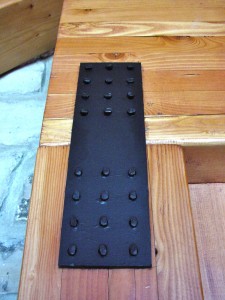
Custom-fabricated metal brackets are another option. Brand a full-size model of the bracket you demand using corrugated cardboard and hot melt glue, and so hand it over to a welding store to be built in mild steel.
If you've got access to timbers where you lot live, your habitation could reflect the heritage of craftsmanship and timber availability – a heritage that not everyone around the world enjoys. Visible timbers aren't for every edifice and every possessor. That said, if you lot've ever felt an attraction to large timbers, know for sure that information technology's easier than yous might realize to bring them into your life.
Timber Frames Homes: The Prefab Option
A scattering of suppliers around the world offer custom-cut timber frame packages built to your particular design. It'southward an selection that eliminates the need for skilled labour on site, though you lot notwithstanding demand a strong, burly crew to assemble the parts. Joints are milled with large machines in a mill setting, with the numbered timbers fix for associates when they arrive.
Timber Frame Homes: Dealing With Sap
 Virtually timber frames are congenital from softwoods, and this means that oozing sap may prove up – and go along showing upwardly – effectually knots. This is especially true if you're working with spruce in exterior applications. Although there's cypher that reliably stems the menses of sap from a determined knot, there are ways of periodically cleaning off the broth. A putty knife is platonic for scraping off the bulk of hardened sap, and turpentine is the ideal solvent for removing annihilation remaining. You'll accept much better results if you allow fresh sap harden for a while. It comes off easier that way, even if you're using turpentine. Information technology'southward surprising how long an oozy bandbox timber can go on on oozing. I've seen them do it for years.
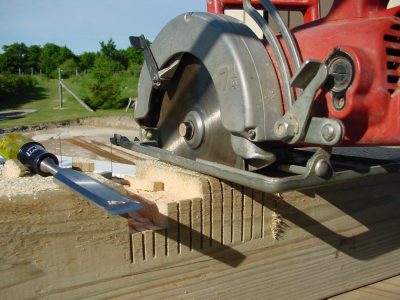
Outdoor projects let you lot proceeds low-gamble experience with timbers where precision doesn't affair quite as much equally with interior structures. One of the almost mutual operations involved in outdoor timber work is the lap joint. Notches are cut half way through the thickness of interlocking pieces of wood, assuasive them to overlap each other evenly, forming a strong, 90º connection. Multiple cuts with a manus-held round saw defines the width and depth of each lap, while also making it easy to knock waste wood out of the joint area with a mallet and chisel.
Click below to sentry my video tour of simple, timber frame details you can apply to outdoor edifice projects you may have planned for your place. I think yous'll like this video.
Source: https://baileylineroad.com/timber-frame-homes-how-to/
0 Response to "what finish is best to use on outdoor timber frame"
Enviar um comentário